
What “Advanced” Really Means In Modern Beauty Education
Beyond Pretty Looks: Repeatable, Studio-Ready Results
For hobbyists, a look is “good” when it flatters their own face under everyday lighting. At a professional level, that bar shifts to: clean, consistent results on many faces, in many environments, under unforgiving cameras. It’s no longer about one perfect night-out glam; it’s about being able to reproduce quality on oily, dry, textured, mature, or reactive skin, under overhead fluorescents or harsh LED panels.
In this space, restraint becomes as important as drama. A smoky eye that works in the mirror might turn muddy in close-up video. Heavy highlighter that looks fun for selfies may explode into distracting hotspots under a key light. Advanced training teaches not only “how to add,” but when to hold back, how to justify every stroke, and how to make deliberate choices that stand up to zoom lenses and long hours on set or on location.
From “Cute Tricks” To Technical Control
Many self-taught techniques lean on feel: tapping foundation with fingers, blending “until it looks right,” or guessing product amounts. That can work on your own face, but it falls apart when timing is tight, the client is anxious, or skin is unpredictable. Higher-level programs focus on control and repeatability: pressure, product pickup, placement, layering order, and precise transitions.
You learn to map bone structure before contour, adjust blush height to eye spacing, and sequence base products so they don’t pill or separate. Instead of hoping an eye look “blends eventually,” you plan zones: main color, transition, depth, and highlight. That shift—from improvising to predicting outcomes—creates the calm, confident energy clients and creative directors look for on demanding jobs.
Inside A High-Level Training Room
How Pro Classrooms Mimic Real Studios
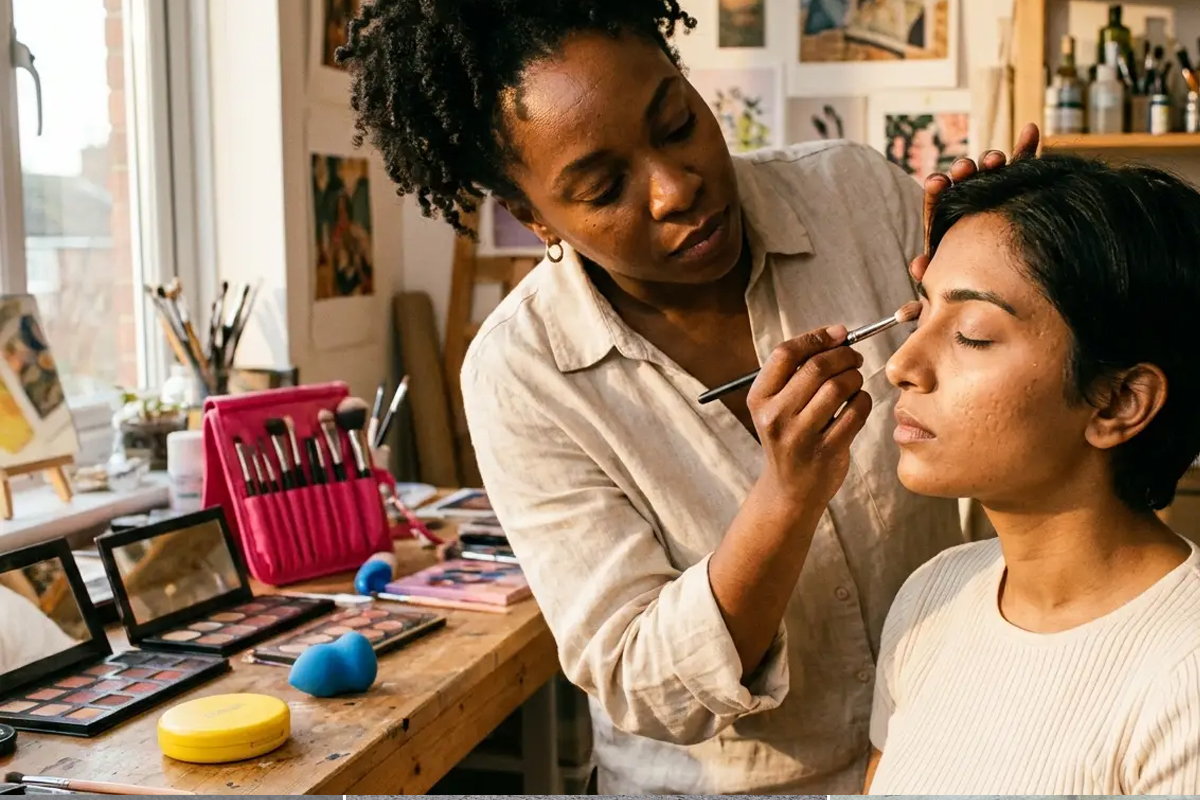
Walk into a serious advanced class in the United States and it feels closer to a working set than a casual workshop. Lighting is adjustable and bright enough to expose every pore. Workstations are arranged for both detailed focus and quick changes, with space for models, equipment, and sanitation zones. You’re constantly switching between “careful, quiet” detail work and faster, almost backstage-style pacing.
Sanitation isn’t a side note; it’s baked into the routine. Disposable tools, brush cleaners, clear separation of clean and used items, and product decanting become non‑negotiable habits. Instructors often watch your hygiene practices as closely as your blending. The goal is for safe practice to feel automatic, so when you move into bridal suites, sets, or crowded dressing rooms, you’re not improvising health standards under pressure.
A Day That Blends Science, Strategy, And Hands-On Practice
Most advanced days start with seated theory: skin structure, skin types, product categories, label reading, and how formulas behave under heat, sweat, and time. You learn why a silicone-heavy primer might save one complexion and ruin another, how film-formers affect long wear, and why some products “flash back” on camera. This isn’t chemistry-for-chemistry’s-sake; it’s about predicting performance.
Then come long, supervised practical blocks. You’ll cycle through different models, skin tones, ages, and conditions. One session may focus on deeper complexions without ashiness; another on delicate, lined skin that hates powder. Instructors demonstrate, then watch your application up close, correcting tiny things—jawline edges, lower-lash transitions, lash placement, texture emphasis—that are invisible in casual selfies but brutal in HD. Over time, your eye sharpens and your hands adjust almost automatically.
Science On The Skin: Products, Ingredients, And Safety
Reading Formulas Like A Working Artist
At a pro level, choosing a foundation or primer by “vibe” isn’t enough. You start by looking at what’s actually in the bottle: how hydrating agents, emollients, pigments, and stabilizers work together. You learn to spot when a “long-wear” base might suffocate a fragile barrier, or when a sheer tint can’t possibly hold under stage lights.
You also pick up a practical vocabulary for talking with clients who care about “clean,” “natural,” or “sensitive” choices. You don’t need to be a cosmetic chemist, but you do need to know which formulas are usually kinder to easily irritated skin, which combinations are more likely to pill or crack, and when to steer someone toward gentler prep rather than simply packing on concealer. That mix of empathy and science is part of being taken seriously in a health-conscious market.
Safety, Allergies, And Invisible Boundaries
Regulatory rules in the U.S. can feel dry, yet they quietly shape real work. Advanced programs translate these expectations into everyday decisions: no double-dipping into cream products, no applying around active infections, no off‑label experiments that turn you into an unofficial formulator. You learn to read warning statements, respect recommended use areas, and avoid making medical-style claims when you talk about products.
Equally important is knowing when to say no. If a client insists on using a product that has triggered reactions before, or shows up with inflamed skin asking for heavy coverage, advanced training prepares you to respond kindly but firmly. Clear boundaries, paired with solid hygiene, protect your clients first—and also protect your license, your insurance, and your long-term reputation.
| Course Focus Area | What You Actually Learn In Depth | Who Typically Benefits Most |
|---|---|---|
| Skin-focused complexion work | Matching undertones, layering sheer corrections, managing texture under close-up cameras | Artists working with on-air talent, corporate headshots, professional branding shoots |
| Long-wear and event looks | Heat- and humidity-aware product sequencing, durable color placement, fast touch-up strategies | Bridal specialists, event glam artists, artists in busy hospitality or nightlife venues |
| Ingredient and product literacy | Label reading, basic compatibility, practical safety and tolerance awareness | Artists serving sensitive, mature, or high-frequency-wear clients |
Learning to match these streams to your clientele and goals keeps your kit lean and your decision-making grounded in more than marketing promises.
Career Tracks: From A Niche To A Signature
Bridal, Editorial, Or Complexion-First: Very Different Lives
Nailing a soft-glam bridal look is only part of what wedding specialists do. They manage timelines, calm nerves, work in cramped hotel rooms, and create looks that survive tears, sweat, and flash photography while still flattering in natural afternoon light. Training aimed at this path leans heavily on durability, client communication, and contingency planning—how to fix surprise breakouts, late arrivals, or last‑minute style changes without panic.
Editorial and fashion work flips the focus. Here, the “client” is the image: creative direction, wardrobe, lighting, and layout. You might be asked for barely-there gloss one moment and neon graphic liner the next—always under tough scrutiny from photographers and art directors. Courses targeting this lane emphasize concept building, moodboards, reading lighting setups, and creating cohesive series, not just one-off pretty faces.
Complexion- and skin-aesthetic‑driven paths sit somewhere between beauty and skincare. Artists on this track obsess over texture and subtle shifts in tone rather than dramatic effects. Education here digs into reading skin at a glance, choosing feather-light corrections instead of heavy coverage, and collaborating smoothly with skincare pros. It suits those who savor “no-makeup-makeup” looks that still hold up under magnification.
Mixing And Matching A Personal Direction
Most established pros in the U.S. don’t live in a single box. A common pattern is a primary lane—say, weddings—paired with a secondary specialty that makes your work distinct, such as editorial-inspired color stories or unusually refined complexion work. Smart advanced courses acknowledge this reality, offering pathways that cross-pollinate instead of forcing you into one identity.
Choosing the right mix starts with honest reflection: Which jobs leave you energized instead of drained? Which looks do people keep bookmarking or saving from your feed? From there, you pick programs whose projects, lighting setups, and portfolio-building assignments clearly support that direction. The goal isn’t to learn “everything,” but to grow deep roots in one main lane while keeping enough breadth to handle real-life variety without panic.
Bringing Studio-Level Skills Into Everyday Work
Practicing “Set-Ready” Habits On Regular Days
You don’t need a big production to train like you’re headed there. You can start by checking your daily looks in different lighting, taking tight and wide-angle photos, and trying to recreate your own successful applications a few days later. If they’re hard to reproduce, that’s a sign to refine your product amounts, order of application, and brush choices until they feel predictable.
Over weeks and months, choosing one micro-skill per day—like under-eye texture control, lash band invisibility, or blush balance—creates more growth than occasional marathon sessions. Pair that with honest self-critique, or feedback from trusted peers, and your everyday clients will quietly notice: appointments feel smoother, looks last longer, and results feel tailored instead of generic. Those small, consistent upgrades are exactly what advanced courses are built to accelerate—once you’re ready to step into them with clear goals and a working artist’s mindset.
Q&A
-
What can I expect to learn in Advanced Makeup Courses beyond basic makeup skills?
Advanced courses dive into facial analysis, undertone theory, complex blending, corrective techniques, long‑wear product layering, HD/4K camera requirements, and working efficiently under time pressure on real-world sets or events. - Why are Expert Makeup Guides important even for experienced artists?
Expert guides help artists stay updated on new formulations, FDA-related considerations, inclusive shade ranges, evolving trends like clean or glass skin, plus advanced troubleshooting for different skin types and lighting conditions. -
What distinguishes Beauty Techniques For Professionals from consumer-level tutorials?
Pro techniques focus on durability, color accuracy under varied lighting, product economy, custom mixing, and adjusting looks for photography vs. in-person viewing, while also addressing speed and repeatability for multiple clients.