
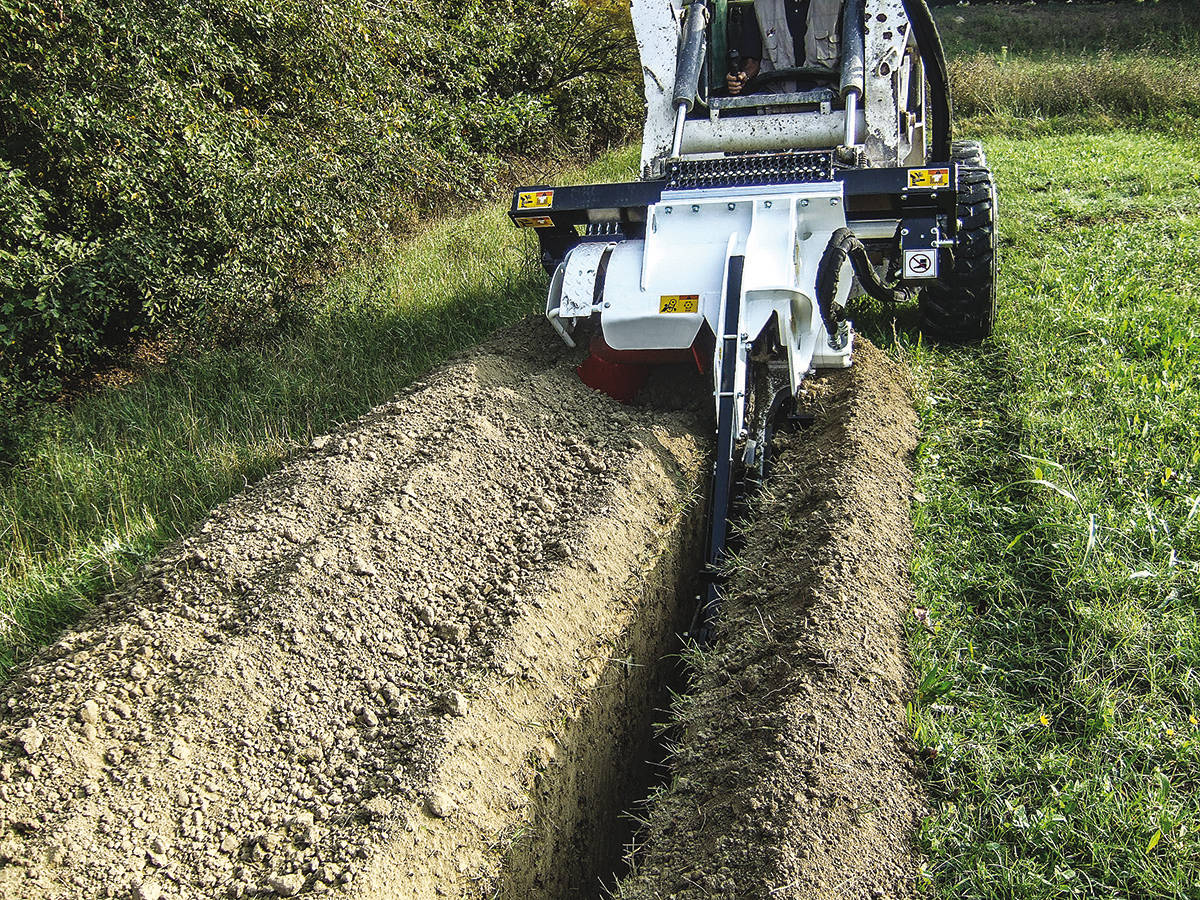
Exploring the Types: From Handheld to Ride-On Trenching Machines
Chain trenchers come in various forms, each designed for specific tasks and environments. Understanding the different types can help in selecting the right tool for the job, optimizing efficiency and minimizing project costs.
1. Handheld Trenchers
Handheld trenchers are compact and lightweight, making them ideal for small-scale projects and tight spaces. These trenchers are typically powered by gasoline engines or electric motors and are designed for digging narrow trenches for irrigation lines, low-voltage wiring, or edging. Their portability allows for easy maneuverability around obstacles and in areas with limited access. While they offer convenience, their digging capacity is limited compared to larger models.
2. Walk-Behind Trenchers
Walk-behind trenchers offer a step up in power and digging capacity compared to handheld models. These machines require the operator to walk behind and guide them, making them suitable for medium-sized projects such as installing drainage systems, utility lines, or landscape edging. They generally feature more robust engines and deeper digging capabilities than handheld trenchers, providing a balance between portability and performance.
3. Ride-On Trenchers
Ride-on trenchers are the largest and most powerful type of chain trencher. Designed for large-scale projects such as installing pipelines, cables, or drainage systems over long distances, these machines allow the operator to sit and control the trencher from a comfortable position. Ride-on trenchers offer increased digging depth, speed, and efficiency, making them suitable for professional contractors and demanding applications. Some models come equipped with advanced features such as GPS navigation and automated digging controls.
4. Micro Trenchers
Micro trenchers are specialized machines designed for creating narrow, shallow trenches, typically for fiber optic cable installation in urban areas. These trenchers use a cutting wheel or a chain with closely spaced teeth to create a very narrow trench, minimizing disruption to existing infrastructure and reducing the amount of excavation required. Their compact size and maneuverability make them well-suited for working in congested urban environments.
Choosing a Chain Trencher for Home Use: Key Considerations
Selecting a chain trencher for home use requires thoughtful evaluation of project needs, budget, and ease of operation. Understanding the benefits and limitations of different models helps homeowners make the best choice.
1. Size and Portability
For residential applications, compact and lightweight trenchers tend to be the most practical and efficient option. Their reduced size and manageable weight make them especially easy to operate in tight or restricted spaces, such as gardens, flower beds, or narrow pathways alongside driveways. This enhanced maneuverability not only simplifies the digging process but also reduces physical strain on the user, allowing homeowners to complete their projects more comfortably and with greater precision. Additionally, these smaller machines are often easier to store and transport, further adding to their convenience for typical household tasks.
2. Power Source and Operation
When choosing a trencher for home use, homeowners must carefully consider whether to opt for an electric or gas-powered model. Electric trenchers are known for their quiet operation, minimal maintenance requirements, and environmentally friendly nature, which makes them especially well-suited for smaller projects or work in enclosed or noise-sensitive areas. On the other hand, gas-powered trenchers provide more robust power and greater mobility, allowing them to handle larger, more demanding tasks with ease. However, these models typically require more regular maintenance and produce emissions, which may be a consideration for those looking for a low-maintenance or eco-conscious option. Ultimately, the decision depends on the specific needs of the project, the working environment, and the user’s preferences regarding convenience and performance.
3. Safety and Features
Safety is a critical consideration when selecting equipment for home use, and trenchers are no exception. Modern trenching machines often come equipped with advanced safety features designed to minimize the risk of accidents and injuries during operation. For instance, many models include automatic shut-off mechanisms that activate if the machine encounters an obstacle or if the operator loses control, effectively preventing potential hazards. Some trenchers also feature sensors or obstacle detection systems that help avoid collisions with underground utilities or unexpected objects in the digging path. By prioritizing these safety functions, homeowners can significantly reduce the chance of mishaps, ensuring not only their own protection but also a smoother, more efficient trenching experience. Taking the time to understand and utilize these safety technologies is essential for safe and confident operation in any residential project.
Navigating the Market: Buying vs. Renting Trenching Equipment
Choosing between buying and renting a chain trencher involves careful consideration of project scope, budget, and long-term equipment needs. Understanding the advantages and disadvantages of each option is crucial for making an informed decision.
1. Initial Investment and Budget
Purchasing a chain trencher requires a significant upfront investment. The cost varies depending on the model, size, and features. Renting, on the other hand, involves paying a fee for a specific period, which can be more budget-friendly for short-term projects. Consider the overall project budget and whether the cost of ownership is justifiable based on anticipated usage.
2. Project Duration and Frequency of Use
If trenching is a frequent requirement, buying a chain trencher might be more economical in the long run. However, for occasional or one-time projects, renting is often the more practical choice. Assess how often the equipment will be used to determine the most cost-effective approach. Regularly used trenchers may justify the initial expense of purchasing, while infrequent use favors renting.
3. Maintenance and Storage
Owning a chain trencher comes with the responsibility of maintenance, repairs, and storage. These factors add to the overall cost of ownership. Renting eliminates these concerns, as the rental company typically handles maintenance and storage. Evaluate the resources available for equipment upkeep and storage when making your decision. Renting can free up time and resources that would otherwise be spent on maintenance.
4. Equipment Variety and Upgrades
Renting provides access to a wider variety of chain trenchers, allowing you to select the specific model best suited for each project. Renting also allows you to utilize newer models and technologies without the long-term commitment of ownership. Purchasing may limit you to a single model, which may not be ideal for all trenching tasks. Consider the need for equipment diversity and the desire to stay up-to-date with advancements in trenching technology.
Q&A
Question 1: What are the primary components of a chain trencher, and how do they work together during the digging process?
Answer: A chain trencher's core components are a digging chain with cutting teeth, a boom for support and guidance, and a power unit (usually a diesel engine). The engine powers the chain's rotation, causing the teeth to excavate soil. The excavated material is then conveyed upward and deposited to the side by an auger or conveyor system. The boom's adjustable height controls the trench depth.
Question 2: What are the different types of chain trenchers available, and what factors should influence the choice of a specific type for a project?
Answer: Chain trenchers range from handheld (small-scale projects, limited digging capacity) and walk-behind (medium-sized projects, increased digging capacity) models to larger ride-on trenchers (large-scale projects, high speed and efficiency) and specialized micro trenchers (narrow trenches for fiber optics). The choice depends on project size, soil conditions, budget, and the required trench dimensions.
References:
- https://www.equipmenttrader.com/Case-Trenchers/equipment-for-sale?make=Case%7C2322418&category=Trenchers%7C2000216
- https://factorypure.com/products/brave-compact-trencher-with-shark-chain-18-max-depth-and-honda-gx200-engine-6-5-hp-gas-brpt18-new
- https://www.equipmenttrader.com/Trenchers/equipment-for-sale?category=Trenchers%7C2000216